
…….and what it means for you
This is about flooring, but if you buy anything from China, you need to read it.
You’ll have noticed Chinese prices getting lower and lower. The Chinese have a word for this: neijuan, or “involution”. It means a downward spiral driven by oversupply and cutthroat competition. With anti-dumping duties now shutting much of Europe and America to Chinese exports, it’s fiercer than ever.
Desperate factories resort to desperate measures. Some simply absorb the losses and hope their rivals fall first. If you’ve invested millions, selling below cost for a while is better than losing the lot. But there are more nefarious strategies too.
Here’s an awkward fact. Right now, decent ABC-grade oak engineered flooring costs roughly US$28/m² to make. Yet some quotes are coming in close to US$21/m². At that price, you can’t even buy the plywood, the top layer, the glue and the coating. So what’s going on?
Here’s what I’ve seen with my own eyes:
– Cheap plywood that saves a few renminbi, but is softer and less stable.
– Low-grade top layers sold as a higher grade. This is very common. Grading in China isn’t always clearly defined, so lamella suppliers and factories alike push the envelope, and the buyer pays for a grade they don’t get.
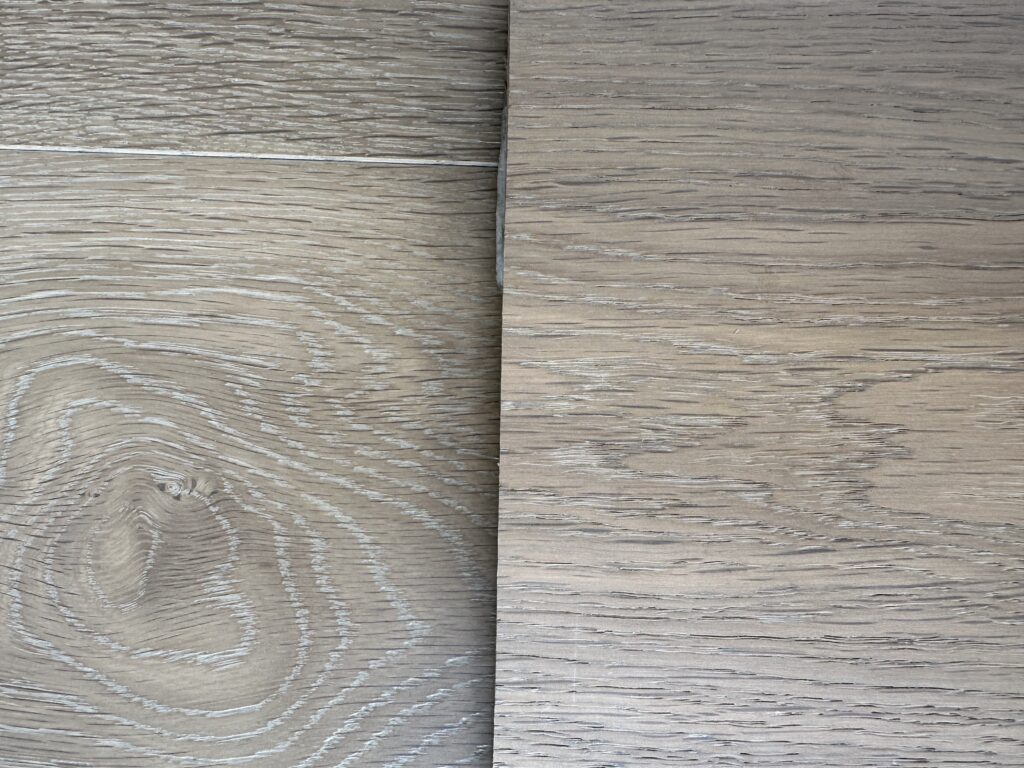
– Low-grade top layers, disguised. Some factories buy cheap lamellae full of knots and defects, fill them with putty, then glue a 0.6mm veneer of clean wood over the top. It looks like A or AB grade, but it’s lipstick on a pig.
– Cheap domestic glues and coatings, which very likely don’t meet your market’s emissions or performance standards.
These tactics cut the red ink and keep a factory alive a little longer. The board looks fine in the showroom. The trouble comes later, when the surface wears through, because that floor can’t be sanded or recoated. The homeowner ends up with a ruined floor, the retailer gets the complaint, and the importer’s name is on it.
Some buyers know what they’re getting. Many don’t. They think they’re comparing like with like, but they aren’t.
The old adage still holds: if it looks too good to be true, it is.
Before you accept the lowest quote, check the grading, the core species, the real wear-layer thickness, the glue and finish, and the certification behind them. And don’t rely on paperwork. If someone intends to defraud you, the paperwork will say whatever you want it to. The checks have to be done before and during production, not after, and not on documents alone.
China is perfectly capable of making great products, and plenty of companies do, but you have to find them and you will have to accept that the price of buying quality is the price. It is usually a few percent more, but it is cheap insurance, especially in litigious markets. Also, if anti-dumping duties are your problem, talk to me because some of my most reliable supplies have moved from China to Southeast Asia and are not subject to these duties.
At Ecquality, we’ve worked in the Chinese flooring industry for nearly 20 years, and in the wood trade for 30. We know the factories, we know the tricks, and we check the product ourselves. We’ll never be the cheapest quote you get, but you’ll know exactly what you’re buying.
Terry Newman
CEO, Ecquality Timber Products Co., Ltd
Chairman, Manufacturing, Sourcing and Supply Chain Committee, AustCham Shanghai
#flooring#engineeredflooring#timber#sourcing#China#supplychain