
Two parquetry panels can look almost the same in a showroom and still be built in completely different ways. How a panel is made affects how thick it is, how it’s installed, how stable it stays and how many times it can be sanded back over its life. There are three basic methods: solid parquetry, engineered parquetry and marquetry (often called appliqué on ply). Each has its own variations.
1. Solid Parquetry
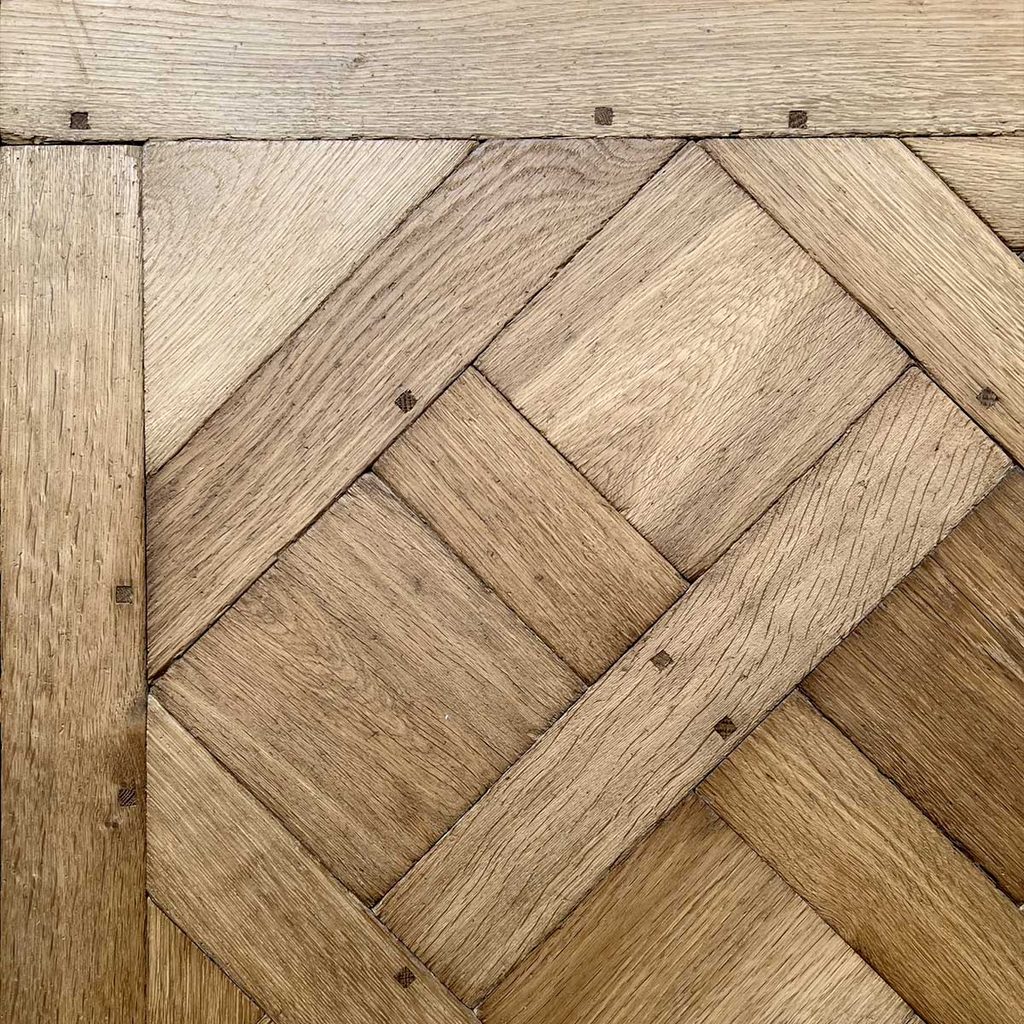
Méthode traditionnelle: pegged mortice and tenon
This is the original method, and it’s about 400 years old. It was first used at the Palace of Versailles, which is why pattern parquetry panels are still often called Versailles panels.
Each element of the panel is joined to the next with a mortice and tenon, and the joints are locked with timber pegs. No metal fixings or modern adhesives are needed to hold the panel together. A finished panel is normally 23mm thick. It takes more skill and time than any other method, but a well-made panel is extremely strong and can be sanded and refinished many times. That’s why it’s still the choice for heritage restorations and high-end projects.
Modern solid: tongue and groove
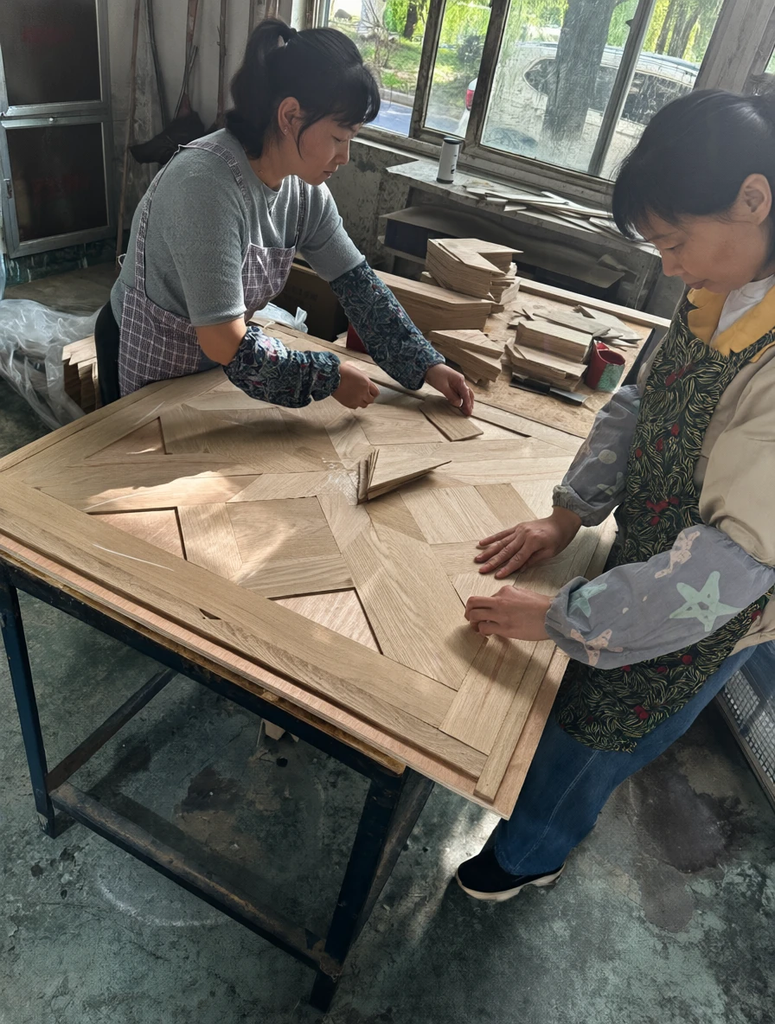
This is a modified version of the traditional method. All or some of the elements are machined with tongue and groove joints instead of mortice and tenon, and the panel is held together with hardware, glue, or both. You still get a solid timber panel with a traditional look, but it’s quicker and cheaper to make.
Loose-element method: butt-jointed
The simplest solid method. The elements are just butted against each other and held together either with staples underneath or with tape on the top face. Taped panels are glued down with the tape still on. The tape is then removed, and the surface is puttied and sanded. The panel only becomes one piece once it’s on the floor, so the quality of the result depends heavily on the installer.
This method also needs much more work on site, and it isn’t suited to pre-finished projects because the surface has to be puttied, sanded and coated after installation. The panels themselves are cheaper, but once on-site labour is added, a more expensive pre-finished panel can work out cheaper overall, especially where labour costs are high.
2. Engineered Parquetry
Engineered panels are built the same way as the modern solid versions, but from engineered boards. Instead of solid timber all the way through, each element has a sawn hardwood top layer (lamella) bonded to a stable backing. Top layers are usually 6mm, 4mm or 3mm. A thicker top layer can be sanded more times over the life of the floor.
Because the backing resists movement, engineered parquetry is more dimensionally stable than solid. That makes it a good choice for concrete slabs and climates with big seasonal swings in humidity. For underfloor heating, a 3mm or 4mm top layer is the best choice, and 6mm is best avoided. Because the top layer is sawn, it looks the same as solid timber once installed.
3. Marquetry (Appliqué on Ply)
Marquetry is made in a completely different way. Pre-cut pieces of veneer are glued down onto a single sheet of plywood that is slightly larger than the finished panel. The whole sheet is pressed, then machined to its final size with tongue and groove on the edges. Last of all, the surface is repaired and coated.
Marquetry usually uses very thin peeled veneers of 0.6mm or 1.2mm. Because peeled veneer is cut differently from sawn veneer, it has a different look from the sawn top layers used in engineered parquetry. Thin veneers make intricate, detailed designs possible, but they allow little or no re-sanding.
You can also make marquetry with 3mm or 4mm sawn veneers, but it has to be done carefully. The moisture content of the veneer and the plywood must be closely matched, or the panel may distort. When thicker top layers are used, we recommend keeping panels to about 600 × 600mm or smaller to reduce that risk.
At a Glance
| Method | Construction | Typical top layer | Key point |
|---|---|---|---|
| Traditional solid | Pegged mortice and tenon | Solid, 23mm overall | Original Versailles method, most durable |
| Modern solid | Tongue and groove, hardware and/or glue | Solid | Traditional look, more efficient to make |
| Loose-element | Butt-jointed, staples or face tape | Solid | Cheapest panel, most site work, not for pre-finished projects |
| Engineered | As modern solid, on engineered boards | 3, 4 or 6mm sawn | Stable; 3–4mm best for underfloor heating |
| Marquetry | Veneer pressed onto one ply sheet | 0.6/1.2mm peeled, or 3–4mm sawn | Intricate designs, careful MC control needed |
Choosing the Right Method
The best method depends on the project: the subfloor, the climate, whether there is underfloor heating, the budget, local labour costs, how intricate the design is, and how long the floor needs to last. Remember to compare installed cost as well as panel price. At Ecquality we make parquetry using all of these methods, from traditional pegged Versailles panels to engineered and marquetry designs. If you’d like to talk through which one suits your project, contact us.