

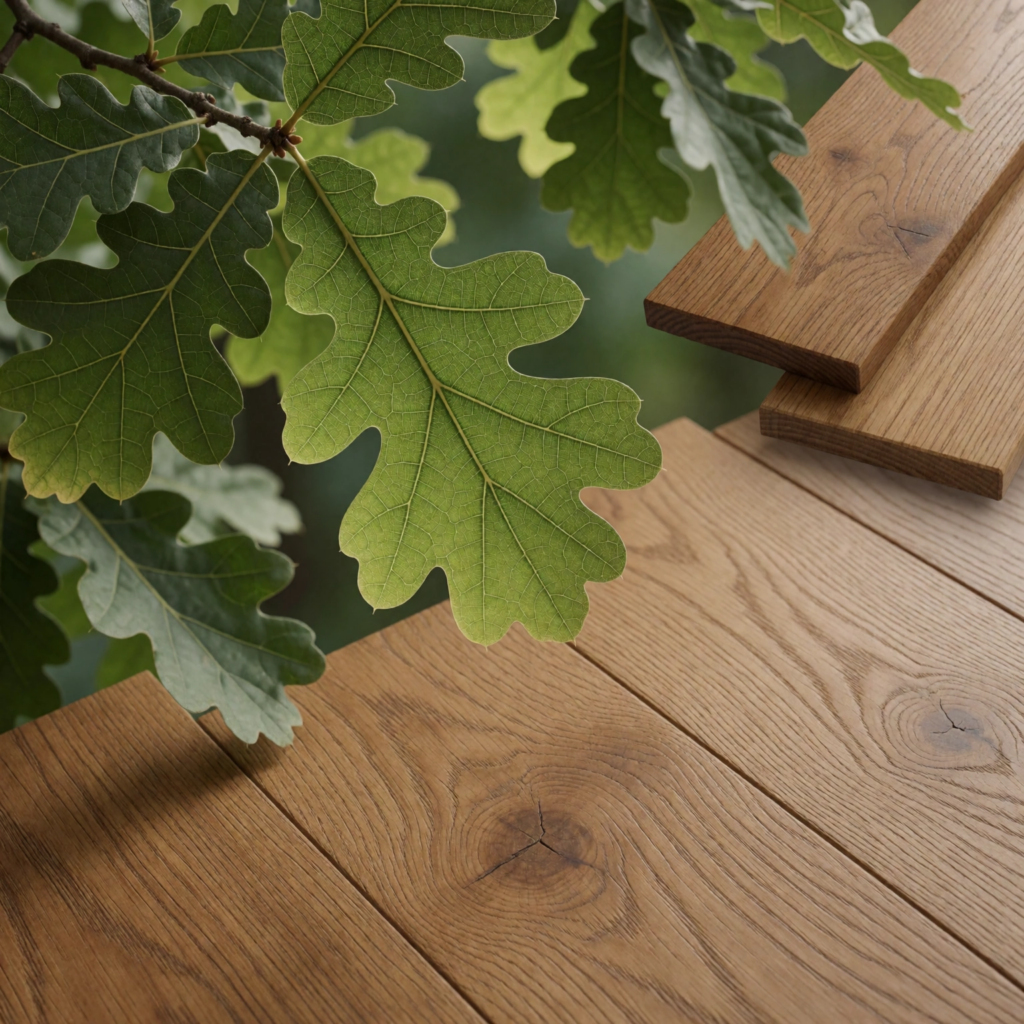
Oak is by far the most widely used wood flooring species. That is because it grows widely across the Northern Hemisphere from the temperate zones of the British Isles, Western Europe, the Caucasus, Russia, Western and Central Asia, and through parts of northern China and Japan. It is prolific in the United States, notably in the Northeast, the Southwest and throughout the Appalachian region.
True Oaks all belong to the Quercus species, and while there are subtle differences, the main divide is between White and Red Oaks, the latter only native to the Americas. White Oaks have pale-to-honey heartwood, tight growth rings, strong reverberative figure in quartersawn cuts; excellent aging in light exposure. Red Oaks on the other hand have heartwood ranging from pinkish to reddish-brown; more pronounced grain and rays; can show more colour variation with light exposure; and are widely used in flooring with stained finishes.
Most of the international Oak trade is in White Oak, and while there are subtle differences, to the untrained eye they are not easily distinguished. Furthermore, hybridization and regional provenance can blur clear species boundaries in wood characteristics. From a practical point of view, grading is probably far more important than provenance when it comes to appearance.
The other important issue when it comes to Oak is sustainability. In this case provenance is important, as is certification. Suppliers should be able to provide clear documentation of log origin, harvest location, and forest management practices. Many factories don’t have chain-of custody certification because they manufacture multiple species and source from many suppliers, however it should be possible to provide redacted invoices proving provenance. Almost all major sawmills can provide either FSC of PEFC certification for their products. These schemes ensure that harvesting complies with local laws and internationally accepted environmental standards.